
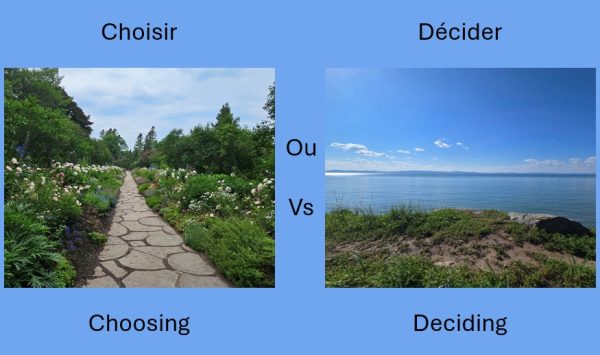
There are words we use every day without a second thought. Choosing and deciding are two of them. In a manager’s daily routine, they slip casually into conversations, show up on meeting agendas, and punctuate action plans. We mechanically say that we are « making a decision, » « making a choice, » or « asking the team to weigh in. » Yet, behind this apparent synonymy lies a subtle, profound, and sometimes deeply uncomfortable nuance.
This distinction is not merely conceptual or linguistic; it is deeply introspective. It acts as a mirror held up to our own posture, revealing our intimate relationship with power, accountability, risk, and uncertainty. More importantly, it defines the degree of autonomy we grant, or deny, to our people.
Are we choosing, or are we deciding? And above all, do we let our teams simply choose, or do we truly allow them to decide? To understand, we must first restore the true weight of these two verbs.
Choosing: The Act That Optimizes, Reassures, and Secures the Framework
To choose is to operate within a pre-established boundary. When you choose, the options are already there, visible, structured, and quantifiable. Your role is to compare, evaluate, sort, and select the best possible alternative. In this sense, a choice is an essentially reactive and analytical gesture: it responds to a given situation to optimize it, but it does not transform it.
This gesture speaks volumes about our need for security. Favoring choice over decision often reveals a preference for the familiar, an attachment to control, and a strong ability to analyze a situation without fully committing to it personally. It is a rational, useful managerial act, and one that is rigorously necessary for the day-to-day running of a business. However, it says very little about our deeper intent or our leadership.
Risk Management in the Act of Choice
We can certainly make a choice when risk is involved, but on one essential condition: that the risk is contained within the existing options, and that it is measurable, predictable, and purely technical. The risk is then nothing more than an accounting parameter, not an issue of personal exposure. Choosing in a risky environment amounts to saying: “Based on our analysis, I am taking the least risky or most profitable option.” This is sound management, but it is not yet leadership.
Deciding: The Act That Commits, Exposes, and Transforms Reality
Deciding involves an internal shift of an entirely different nature. It is a taking of a stand, a new direction, and sometimes a pure creation. Unlike a choice, a decision is a proactive gesture. It does not merely respond to a situation: it radically transforms it, even if it means breaking the existing framework.
A decision is the ultimate indicator of our values, our courage, and our maturity when faced with freedom. Deciding exposes us, commits us, and reveals our true character to others because it is a way of fully owning our role, accepting that we must bear the weight of the consequences alone.
The Existential Risk of a Decision
Risk does not define a decision, but it is its most merciless revealer. We cross the line into a true decision when the risk can no longer be fully measured, when it becomes personal or political, and when the uncertainty is too immense to hide behind data or pre-formatted options.
Deciding in the face of uncertainty means having the courage to say: “I own this direction, even if I do not control everything.” This is no longer a technical act; it is an existential one.
The Managerial Dilemma: Do We Really Ask Our Teams to Decide?
This is where the nuance becomes particularly compelling, and often uncomfortable for a leader. In most organizations, when we claim to give our people the power to « decide, » we are actually asking them to provide a recommendation from a list of pre-approved options. In other words: we are asking them to choose.
We expect them to compare, analyze, and select the best scenario, while we reserve the right to validate or reject their conclusion.
This dynamic subtly betrays the limits of our delegation models. It highlights our difficulty in delegating real risk, our preference for predictable outcomes, and our discomfort with ambiguity. Paradoxically, we demand autonomous teams, but only within a perimeter we control. We want accountable employees, but without their accountability exposing our own leadership.
To delve deeper into this delicate balance: The line between choosing and deciding is at the very heart of trust. In order to explore other perspectives on the mindset required, I invite you to read my articles on delegation :Do not delegate! to rethink how you transfer accountability, as well as team cohesion: Having complete and meaningful debate to learn how to create a psychologically safe space where your team members actually dare to speak up.
Are We Ready to Bear the Risk of Their Decisions?
Allowing a collaborator to decide is not about asking them to sort through existing options. It means authorizing them to create an entirely new option, to alter the framework, and to take a risk that we did not anticipate.
True managerial maturity is measured by our reaction when a team member’s decision destabilizes, surprises, or exposes us. Are we capable of welcoming a direction that does not align with our personal preference? Can we champion a member of our team through an uncertainty that we did not define ourselves?
If our immediate instinct is to take back the reins the moment unpredictability surfaces, to invalidate the initiative to return to a more comfortable choice, or to shrink their space of freedom to protect ourselves, then the autonomy we boast about is nothing but an illusion.
Ultimately, the nuance between choosing and deciding reveals our emotional maturity and our relationship with power. While a choice reassures and states what we prefer, a decision commits and states who we are.
Conclusion: Set the Course, but Let Them Navigate
Let’s be clear: a leader does not need to decide all the time. Methodical choice is indispensable when the environment is stable, the stakes are known, and optimization is the goal.
The danger arises when we do nothing but choose. By systematically staying within the known to avoid risk, we cease to innovate. In an increasingly volatile world, limiting oneself to choosing causes our leadership to contract, exhausts our influence, and condemns our teams to inertia.
A modern leader must be capable of setting the course while letting the team chart the path, thereby opening up a space where we accept to move forward despite what we do not yet know. By observing how often you and your teams choose versus decide, you will measure the true vitality of your organization. It is an invitation to test your capacity to exist within uncertainty, and to allow others to exist there too.
Because in the end, the critical question is not just whether we are choosing or deciding. The real question is: Are we still in motion, and are we allowing our teams to be?
If this topic resonates with your current challenges and you want to learn how to lead with curiosity to give your teams more space to grow, let’s connect to start the conversation.
If you want to give your teams more space to grow, here is an approach: Leading Through Curiosity
Your Executive Coaching Tools: Two Diagnostics to Assess Your Posture
To help you assess your current leadership style and give more breathing room to your people, here are two quick reflection exercises. Take a moment to answer spontaneously with a Yes or No.
Tool 1: Am I Choosing… or Deciding?
- The Framework: Are the options for my current action already defined? Is the scope stable, and is the risk entirely contained within these options?
- The Intent: Am I looking for the « best » technical option rather than defining a vision? Is my action aimed at optimizing what already exists rather than transforming the situation?
- The Commitment: Am I merely selecting a solution after an objective analysis, without feeling that this act commits me personally or reflects my core values?
- The Exposure: Does this action protect me from political, relational, or reputational exposure? Could I change my mind tomorrow without it fundamentally impacting who I am in this role?
- Majority of YES: You are in a Choosing posture. You are rationally managing and optimizing within the box.
- Majority of NO: You are in a Deciding posture. You are cutting through uncertainty and fully engaging your leadership.
Tool 2: Am I Letting My Team Choose… or Decide?
- The Granted Framework: Am I the one who systematically defines and validates the alternatives from which my team member must operate? Is the space I leave them entirely locked down and predictable?
- The Room for Audacity: Is my collaborator implicitly forbidden from creating an unprecedented option, changing the rules of the game, or taking a direction I had not envisioned?
- The Level of Reluctance: Would I feel incapable of owning, supporting, or defending an initiative from my team to upper management if it exposes me personally or deviates from my preferences?
- The Defensive Reaction: Do I tend to feel a strong internal tension, a desire to micromanage, or an urge to restrict autonomy the moment a collaborator’s decision brings unexpected variables?
- Majority of YES: You are confining your team to Choosing. Their autonomy remains under tight control.
- Majority of NO: You are empowering your team to Decide. You accept shared risk and foster growth-driven leadership.