
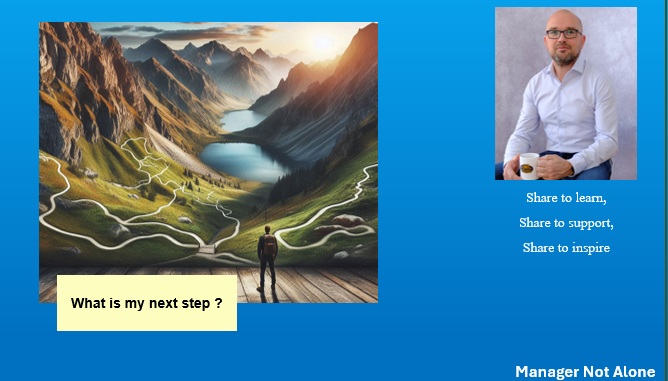
Understand the mechanism.
You will not escape this question in your career, for yourself, your employee or one colleague.
If no one, either colleague or employee never came to talk with you on that matter, looking for guidance or support, you should ask yourself a question. Have you been able to develop a safe space with people around you? Are you approachable and people knows that you are here for them? without safe space, impossible to have true and meaningful discussions on such a delicate topic.
My personal path
I feel lucky to have been able to have a rich career with multiple changes, positions, companies, regions and countries. I made several times this decision of leaving or staying. Now, looking backward, I have no regrets on these choices. I took the time to check where I was feeling, exploring and evaluating alternatives. This journey has made the person I am. How to do so? How can you guide people in this journey to help them taking the best choice for them? This is what this article intends to answer.
Understand this change mechanism
All my changes help me to understand why I was willing to pivot in my career and explore new opportunities. What is this mechanism which make us move outside of our comfort zone? I decompose it in five distinct phases. Each may have a different duration, intensity, and you may experiment back and forth between those.

1. Introspection

When you are wondering if what feel your day is what you are expecting from your life, you are in this phase. This introspection phase could be explicit and easy to detect. Or it could be a mixed feeling of uncertainties, doubt, erosion of your interest in what will happen during your day or in your mission. It’s not because you are in this phase that you will jump into the next phase. During this phase, all your surrounding, casual discussion, observation of what the life looks like for others could be mirror that life is bringing to you to reflect upon your situation. All the doubts, success and failure, obstacles you are facing are fueling this phase.
What can you do as manager or colleague to support this person?
Your listening skill is the key. Invest time on helping this person to structure his introspection, identify the root causes of his feelings. If contextual situation is the trigger, family, general situation (COVID,….) coach this person about patience, resilience and trust in the future and his capabilities. Just being present, listening will help this person as a stabilizer can do to damp emotion waves.
If it’s deep, coach to bring clarity, to help this person by identifying and naming the root cause of his mixed feeling.
Potential coaching avenues
- Career growth is not everyone unique goal. People may be looking for being acknowledge for their contribution, their presence, their excellence in their role. This personality is the silent pilar of the longevity of your group success. By identifying them and helping them to feel valued is one key consideration to keep in mind when you help such individual navigating this phase.
- Lateral moves are not well perceived by everyone, in worst case people may feel demoted. Indeed, the lateral move is a powerful tool, to widen the foundation of knowledge. Fast vertical growth offers no time to have strong foundation. The tallest construction are the ones with robust foundation. Helping people to do not get trapped by the lure of rapid vertical evolution is one of the coaching elements you may want to use too for some individuals. Help them grasping the power of lateral move to support longer term growth.
As a manager you have the ability to
tailor a position, design a mission, that can fulfill some of the need you will have uncover with the employee in guiding him during this phase navigation. Still, the employe must take full ownership of the navigation, you are a facilitator, and not the pilot. It’s a delicate balance to maintain.
2. Exploration & options identification

During this second phase, you start looking around and you identify potential alternatives. One of the facets you will be considering, how deep this change could be: position, department, company, town and why not further away. We have all at one point of time some desire of exploration. Nevertheless, we are not all Indiana Jones, and therefor the depth of exploration will vary for each of us. One interesting element for you to consider, if your exploration is going beyond what you accustomed to think about, it’s because you are looking for a radical change. It could be a symptom of the deepness of your unsatisfaction. This is one of the reasons of a voluntary departure to a new country. An expatriation, is an opportunity that you can grab if we propose it to you, you have the certainty to come back
What can you do as manager or colleague to support this person?
This is the perfect timing to help him exploring option internally in different department, and why not helping him finding an expatriation project. During the discussion, get him expressing the depth of the introspection is doing, and thus helping him sizing the change he is looking for.
As manager you can help him identifying internal options, providing him some advice and activating your HR department. By doing so, you demonstrate the desire to see him growing and achieving his career goal inside the company.
Opportunities outside oy your company are his decisions. For a colleague you can also coach him on defining the criteria that will help him making the best decision for him. Evaluating what matter the most, understanding what he wants to leave and why. This will help him finding the best option.
3. Evaluations

In a conscious manner or not, structured or unstructured, no matter what your approach would be, you will compare all the options, and at the end of the day, you will balance loss versus gain. This is the perfect timing to talk with people you trust. Review with them your criteria, not your decision, your criteria, and try to rank them. Not all the criteria will have the same weight in your decision. It matters the most to know the real trigger. This phase will create the foundation of your decision. Deeper this phase, stronger your decision will be, the best is to have an external view, to make sure you are not forgetting one facet.
What can you do as manager or colleague to support this person?
Your role will be to help the person identify what is important to them to properly rank the options. Depending on the type of personality, this can be qualitative or quantitative. The goal is to be present, to bring calm and serenity so that this becomes a point of stability in the whirlwind of ideas, thoughts, and feelings that this phase can bring.
3. Decision
This phase is different for each of us. Do you need 5 seconds to make your mind, or do you need to spend time to let the decision dive into you. In fact, you have to review the evaluations you have performed. And with one trusted person, articulate your decision. This explanation of your choice cannot last more than 5 minutes.
This explanation is for your, to ensure that you are in peace with this decision and thus you can move forward.
What can you do as manager or colleague to support this person?
Your role is to listen and question, not to challenge. The question will help strengthening the articulation of his decision. It should make it clear and powerful, allowing the person to propel themselves towards their next step. And if this choice was driven by a difficult situation for them, then listening and empathy will be your options. This approach must be balanced because you must also ensure the continuity of business and the well-being of other group members who will observe or endure this departure, this potential rupture.
4. Decision acknowledgement

This phase is usually hidden in your decision. Indeed, deep down, the decision is made. But many external elements create doubt in you, which holds you back from acceptance. The loss of your daily life, your office relationships, the fear of how others might perceive you. Like in an intense project, it leaves you in chaos… all these obstacles only mask the fact that you have already decided. Once again, talking with trusted people can help you take this step that will free the decision made. You must be at peace with the chosen direction and its impact on your image. The trap: trying to justify your departure by adding elements of fault on others to protect your image in a daily life that you will no longer be part of afterwards.
What can you do as manager or colleague to support this person?
Your role is to protect around the effects of this decision, not to miss, omit, but to help convey the rationale of the decision, the future for the person. You must ensure the continuity of business for your company and its employees.
Conclusion
This description of the mechanism can serve as a guide on what you can influence and help with, depending on the phase your employee or a colleague who consults you is in.
Question: And you, how do you help people during this transition?
Continue the reading, part 2: examples
🛠️ Three simple actions to support people in your team
Create a confidential and regular listening space
Once a month, offer each employee a moment where they can talk about their journey, their doubts, their aspirations.
Not to “solve” anything. Just to listen, rephrase, and help clarify.
This allows people to enter the questioning phase with calm and confidence.
Offer a guided evaluation exercise
When someone is exploring options, give them a simple framework:
what I gain
what I lose
what truly matters to me
what I’m missing to be clear
This exercise, done together or independently, helps structure the evaluation phase and reduces emotional confusion.
Introduce the idea of “lateral movement” in development conversations
Many employees don’t think about it. And a simple sentence like:
“What if you broadened your foundation before moving up?”
can open a new perspective, reduce the pressure of vertical growth, and ease discomfort.
👉 These three simple actions strengthen your leadership posture and unlock your potential.