
Trust, a Foundational Pillar
Trust is one of the essential pillars for managing a team. This bond is complex to establish and takes time. So, what if I told you that doubt helps build trust?
Counterintuitive? Perhaps.
Defining Doubt
But first, what is doubt? It stands in opposition to certainty; it’s the sense that reality could be different. What we also call gut feeling, the instinct used to assess a situation. That subtle feeling inside you whispering that something isn’t aligned. A sensor detecting a gap between what your brain analyzes and what your heart feels.
And for scientists? It’s Cartesian doubt, which has structured all scientific discoveries since the 17th century.
Doubt as a Management Practice
Doubt is a strength. Learning to use it, to question it, is a practice in itself.
For example, doubt allows us to conduct risk analysis and methodically identify threats and opportunities. By evaluating probabilities and the severity of impacts, we quantify it, allowing us to focus only on what truly matters. Doubt becomes rationalized, and the project can move forward calmly.
From Doubt to Clarity
When doubts are heard and addressed, a sense of certainty emerges within you, offering clarity and momentum in execution. Learning to do this individually, then fostering the same dynamic within a group, is incredibly powerful.
The Pitfalls of Doubt
But like any force, doubt has its weakness. It can paralyze, become a source of anxiety, especially when it’s neither rationalized nor quantified.
In my career, I’ve witnessed these moments of paralysis. For some, it even led to questioning their own abilities. When stakes are high, people’s safety, financial or reputational risk for the company, doubt can distort our judgment. In a way, we compensate for the magnitude of the stakes by lowering our tolerance for uncertainty.
Creating a Collective Framework to Tame Doubt
In such cases:
Bring everyone together around the table. Make sure your intention is clear and shared, meaning accepted, before even discussing risks.
As an example: For this phase of the project, we’re only focusing on the upcoming test and whether we have enough information to authorize it. This framework, both clear and limited, allows us to approach complexity one step at a time.
Rationalizing Together to Soothe
With this framework, risks are rationalized using everyone’s knowledge. The technical expert is no longer alone in bearing the decision, which reduces uncertainty and the associated stress. This collective rationalization brings clarity and calm. Mastered doubt becomes a balance between intuition and reason, between heart and mind.
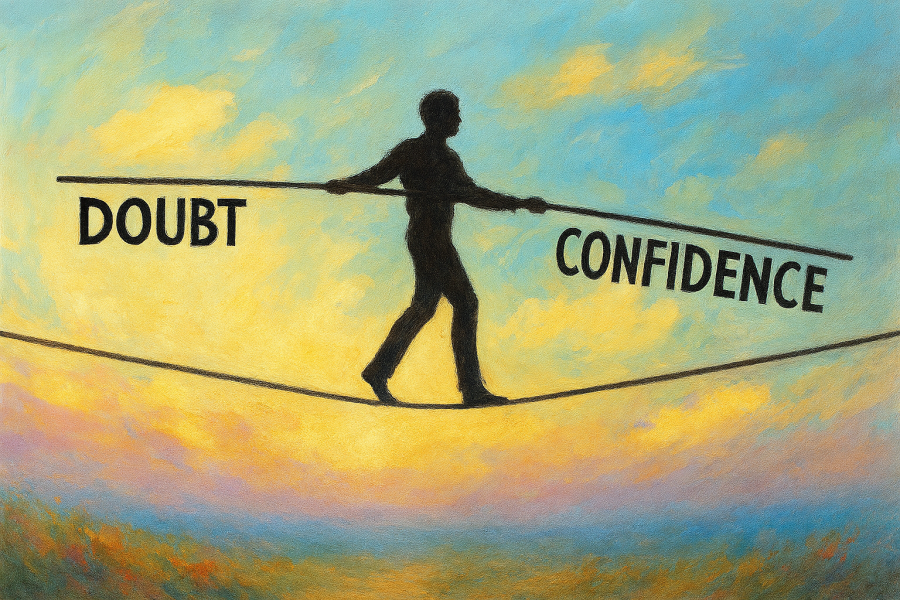
Everything rests on balance.
Doubt in Service of Trust
When mastered, doubt strengthens trust within the team.
To me, doubt will become a fundamental element of your management style, if you learn to master all its facets.
What I propose here is to treat doubt as a point of equilibrium.
A trust… infused with doubt.
A trust… conscious.
Balance, a Dynamic Posture
Balance is a stable position.
That doesn’t mean it’s always the same position. In some situations, you’ll have more doubt than certainty, or the opposite. What matters is avoiding falling entirely to one side.
Avoiding the Two Extremes
Let’s take excessive trust. Just writing that sentence, you can feel it’s not a posture we want to adopt. In that state, we become blind to weak signals, deaf to warnings, impermeable to questioning. Without doubt, you risk facing situations that are very difficult to manage.
And the other extreme: you’re full of doubt, unable to decide or move forward, and again, you’ll face a difficult situation. Because not deciding is deciding: choosing immobility. And in our constantly evolving world, you leave room for competitors to pull ahead. Prolonged inaction simply makes you irrelevant.
The Manager’s Role: Cultivating Balance
That’s why, as a manager, you must master this balance between doubt and certainty so that trust can thrive within your group.
When a project is being prepared or a decision is approaching, create a framework where everyone can voice their doubts. Together, turn them into levers for action.
To go deeper: Trust: The Invisible Foundation of Management
🛠️ Three simple actions to manage doubt within a team
Introduce a “doubt roundtable” for projects
n your project governance, encourage the sharing of doubts, intuitions, or weak signals. Duration: 10 minutes. Everyone listens, and the team decides together on the next steps.
Identify extremes: a weekly act of clarity
Each manager can ask themselves two questions at the end of the week:
Have I ignored a weak signal due to overconfidence?
Have I delayed a decision due to excessive doubt?
Protect your experts: never leave them alone with a critical doubt
When the stakes are high (safety, finances, reputation), always organize a short co‑analysis session to share responsibility and reduce individual pressure.
👉 These three simple actions strengthen your leadership posture and unlock your potential.
Coaching or Mentoring: Your Choice, Your Growth
I’m Franck Dervault, drawing on years of professional experience and now advancing toward certification as a coach. I offer two distinct paths:
- Coaching to help you unlock your own potential through reflection, presence, and guided discovery.
- Mentoring to share lessons, strategies, and insights from my career so you can navigate challenges with confidence.
Whichever path you choose, my goal is the same: to help you realize that you are wiser than you think, with immense potential waiting to be unlocked.
Don’t face management challenges alone: subscribe and receive practical keys every week to help you progress.