
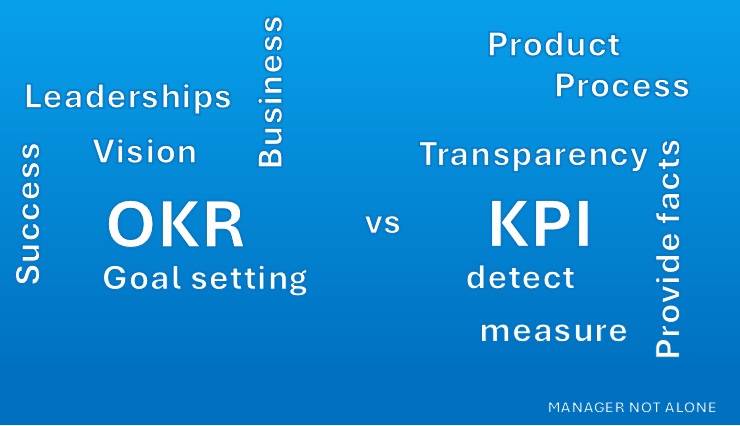
In the dynamic landscape of modern business, a leader’s primary challenge is to steer their team toward success while ensuring the organization’s long-term health. This requires a two-pronged approach: Guiding by establishing a clear vision and mission to guide the team’s efforts and implementing robust monitoring systems to gauge progress and detect potential issues. This article explores how Objectives, Key Results (OKRs), and Key Performance Indicators (KPIs) work together to achieve these goals.
Setting the Course: Vision, Mission, and OKRs
Before diving into metrics and monitoring, it’s crucial to establish a strong foundation: a clear vision and mission. The vision paints a picture of the desired future state, while the mission defines the organization’s purpose and primary objectives. These serve as the North Star, guiding strategic decisions and aligning team efforts. However, a vision without a plan is just a dream. This is where OKRs come in.
OKRs are a robust goal-setting framework that translates vision and mission into actionable objectives. They provide a structured approach to defining ambitious goals (Objectives) and tracking progress (Key Results). Objectives are qualitative, inspirational statements of what we want to achieve, answering the question, « Where do we want to go? » Key Results are quantitative, measurable milestones that demonstrate progress toward the Objective, answering the question, « How will we know if we’re getting there? »
By implementing OKRs, leaders can ensure that every team member understands how their work contributes to the overall mission. This alignment fosters a sense of purpose and ownership, driving motivation and engagement. OKRs also promote transparency, as progress is openly tracked and shared, ensuring everyone is on the same page.
Monitoring the Engine: KPIs for Health and Efficiency
While OKRs guide the direction, KPIs monitor the engine’s health by focusing on specific processes, products, or tasks. KPIs are specific, quantifiable measures used to evaluate the performance of a defined process, the quality of a product, or the efficiency of a task in achieving key business objectives. They provide real-time feedback on performance, allowing leaders to identify trends, detect potential problems, and make data-driven decisions.
By focusing on processes, products, and tasks, KPIs offer a granular view of operations. For example:
- Process-oriented KPIs: A manufacturing company might track the « cycle time of the production process » or « the defect rate in the quality control process. »
- Product-oriented KPIs: A software company could monitor « user engagement with a specific feature » or « the number of bugs reported per product release. »
- Task-oriented KPIs: A customer service team might measure « the average time to resolve a customer support ticket » or « the percentage of first-contact resolutions. »
KPIs can be categorized in different ways. Lagging KPIs measure past process, product, or task performance, providing a historical view. Leading KPIs, on the other hand, predict future performance of these elements, allowing proactive intervention. For example, a lagging KPI might be monthly sales revenue (product-related), while a leading KPI could be the number of sales leads generated (process-related).
KPIs can cause anxiety if poorly implemented. Often seen as micromanagement or blame tools, rather than aids for improvement. To avoid this, involve employees in KPI development. Ensure they grasp their relevance to their work.By tying KPIs directly to processes, products, and tasks, you make them more actionable and relevant to the people doing the work.
The Synergistic Relationship: OKRs and KPIs in Harmony
OKRs and KPIs are not mutually exclusive; they are complementary tools that work best when used together. OKRs set the destination and the roadmap, while KPIs provide real-time feedback on the journey.
Here’s how they work in harmony:
- OKRs define the « what »: OKRs establish the ambitious goals the team wants to achieve, aligning with the organization’s vision and mission.
- KPIs track the « how »: KPIs monitor the processes and activities that contribute to achieving the OKRs, providing data on progress and identifying areas for improvement.
- KPIs inform OKR adjustments: KPI data can reveal potential process dysfunction, which could hinder the achievement of results.
- OKRs provide context for KPIs: KPIs gain meaning when viewed within the context of the overall OKRs. They show how day-to-day activities contribute to the bigger picture.
In conclusion, guiding a team to success requires visionary leadership and meticulous monitoring of process and product performance. OKRs provide the framework for setting ambitious goals and aligning efforts with the organization’s vision, while KPIs offer the real-time data needed to track progress and ensure efficiency. When used in synergy, these two approaches empower teams to achieve their full potential and contribute to the long-term health of the organization.
Nothing is more explicit than a tangible example:
My objective:
I want to become a coach with an active network that helps me identify opportunities.
Key results :
- I will publish two articles in French and two in English on my blog each week for the next 24 months
- I will write a book on personal development inspired by the blog content and feedback received: year 3
- I will complete a coaching training by the end of Dec 2026.
KPI:
- Monitor numbers of impressions and interactions for each publication: help tailor publication strategy.
- Monitor numbers of readers per article: two potential outcomes. The first is to improve publication strategy, and the second is to improve writing skills. A key consideration: I have to accept that some topics have less interest for the majority. It does not mean I should not do it
- monitor the number of followers on my LinkedIn professional page and the number of interactions (Using LinkedIn dashboard) to validate network growth and health.
- Monitor the number of blog subscriptions and the amount of access to the content: This will validate the quality of the articles and writing skills.
What is missing is a quantified target for each KPI and the associated range of variation. It will be developed during spring time after 6 months of blogging.
Question : How do you align strategy and execution ?
Reading : One book to read absolutely : Measure What Matters

A similar perspective could be read in this LinkedIn post of Jay Mount : post and you will have a synthetic table.
Coaching or Mentoring: Your Choice, Your Growth
I’m Franck Dervault, drawing on years of professional experience and now advancing toward certification as a coach. I offer two distinct paths:
- Coaching to help you unlock your own potential through reflection, presence, and guided discovery.
- Mentoring to share lessons, strategies, and insights from my career so you can navigate challenges with confidence.
Whichever path you choose, my goal is the same: to help you realize that you are wiser than you think, with immense potential waiting to be unlocked.
Don’t face management challenges alone: subscribe and receive practical keys every week to help you progress.